TRUCKS: Failed communication of minimum speed penalty ends Jackson Macenko’s night in Bristol
by Brock Beard / LASTCAR.info Editor-in-Chief
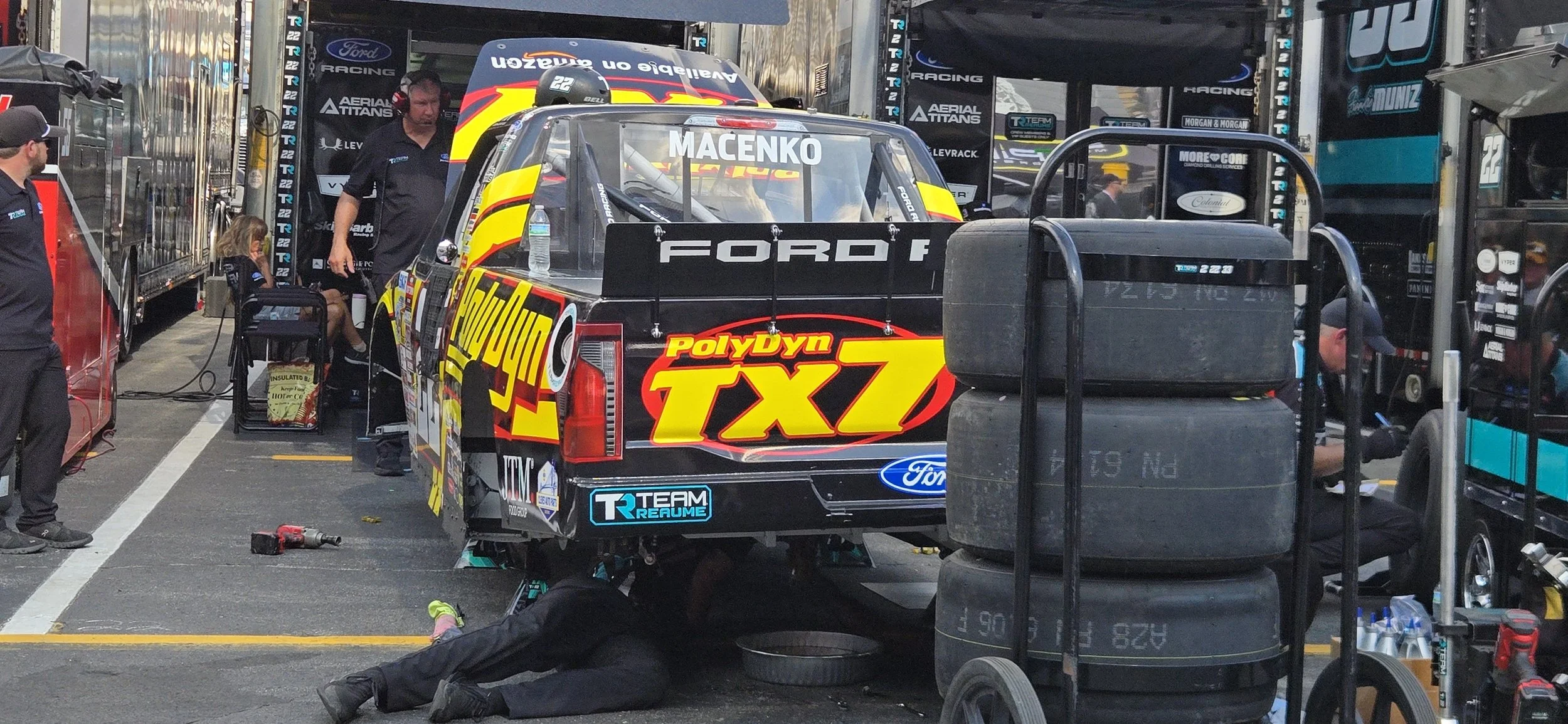
PHOTO: Steven Taranto, @STaranto92
Jackson Macenko picked up the 2nd last-place finish of his NASCAR Craftsman Truck Series career in Thursday’s UNOH 250 presented by Ohio Logistics at Bristol Motor Speedway when his #22 PolyDyn Performance Coatings Ford was parked for running too slow after 39 of 250 laps.
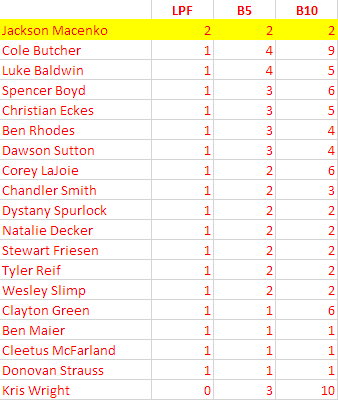
The finish, which came in Macenko’s second series start, was his second of the season and second in as many attempts, dating back to his debut at IRP on July 24, 2026, three races ago. In the Truck Series’ last-place rankings, it was the 10th for running too slow, the 12th for the #22, and the 149th for Ford. Across NASCAR’s top three series, it was the 14th for falling below minimum speed, the 52nd for the #22, and the 1,104th for Ford.
Also, as the first repeat last-place finisher of the 2026 Truck Series season, Macenko now leads the this year’s LASTCAR Truck Series Driver’s Championship with just six races to go – even though he has only two career starts.
After a challenging series debut in Indianapolis, where he dropped off the pace in the middle stages, then pulled behind the wall, Macenko made his first attempt since at Bristol. After driving the #2 at IRP, a truck to be raced by Luke Baldwin for the Bristol race, Macenko was moved to the team’s #22. PolyDyn Performance Coatings, based in Texas, would adorn his Ford with yellow accents on a black base. The biggest logos were reserved for PolyDyn’s TX7 engine treatments, which according to the company website has been promoted in other racing series, including in sports cars and monster trucks. The tailgate featured a QR code to order the product on Amazon.
Macenko was one of 37 drivers entered for 36 available starting spots. In opening practice, he ranked just 35th with a best lap of 16.159 seconds (118.745mph), eight-tenths off the pace of session leader and eventual polesitter Layne Riggs. Near the end of the session, his truck was on jack stands behind the team’s hauler, where the crew worked underneath the left-rear. He was set to roll off fifth for qualifying, when both Tristan McKee’s #77 RCA Chevrolet (due to a fluid leak) and Justin S. Carroll’s #90 Carroll’s Automotive Toyota were still receiving repairs at the start of the session. Carroll, set to roll off first, ended up the lone DNQ, even after lightning in the area cancelled the session with just 28 drivers having taken time.
Securing the 36th and final starting spot was Nick Sanchez, who late in the week was announced as the relief driver for Parker Kligerman, who’s been coming off an illness that kept him out of TheCW’s booth last week in Gateway. Sanchez took the wheel of the Henderson team’s #75 FMS Solutions Chevrolet, and his name was on both the roof rail and rear window. Joining him in the back due to pre-race penalties for unapproved adjustments were both 26th-place starter Connor Hall in the #4 AutoVentive / Precision Vehicle Logistics Chevrolet, and Caden Kvapil – younger brother of Carson – who made his series debut from 34th in Spencer Boyd’s #76 Nor-Cal Equipment Rentals Chevrolet.
Just before the start, NASCAR instructed Kvapil to pull in behind Hall. Intervals seemed to indicate they rolled off in the 34th and 35th spots with Hall 3.441 seconds back of the leader to Kvapil at 3.644. Not far back of Kvapil in 36th was Luke Baldwin in Team Reaume’s #2 Mohawk Northeast Inc. Ford, shown 3.662 behind. By the end of Lap 1, Baldwin was still in the last spot, now 4.439 back of the lead, but pulling alongside 35th-place Kvapil with Macenko now in 34th. Baldwin cleared Kvapil by the start of Lap 3, the #76 now showing 5.328 seconds back of the lead. On Lap 4, Kvapil was 6.590 behind and nearly two-tenths back of Sanchez, who had retaken 35th as Baldwin climbed another spot to 34th.
On Lap 7, Regan Smith, making his first NASCAR national series start in more than seven years, plummeted to last place in Kaulig RAM Racing’s #25 RAM. He crossed the stripe 9.170 seconds back of the lead, just over a tenth back of the now 35th-place Kvapil. By Lap 9, Smith had dropped four-tenths back of Kvapil and was now 10.435 seconds back of the lead.
Macenko’s issues began on Lap 10, when he dropped to the 35th spot, 10.876 back of the lead, as Smith cut his deficit in half to just under two-tenths. On Lap 11, Macenko was now in last place and himself trailing Smith by three-tenths. Smith’s spotter preached patience, telling his driver to climb “one spot at a time.” By then, Macenko’s truck had suddenly lost the handle, appearing “darty” and “snappy loose” according to the spotter. He’d lost so much ground that he had to pull low on Lap 16 to let race leader Riggs put him the first truck one lap down. Those leaders wouldn’t catch and pass 35th-place Smith for another two laps. On Lap 21, Macenko’s team discussed bringing him to pit road to fix the loose condition. He finally did on Lap 24, when the driver came on the radio saying “something broke in the right-rear.” This was a quick stop, though he was now at least two laps down. He returned to the track, but still wasn’t happy with the handling, saying he was “dirt tracking it.” His spotter responded, “I can see it up here – it’s all over the place.” He returned to pit road on Lap 28 where this time the crew looked over the track bar and checked if the chains in the suspension were too tight. He returned to the track again on Lap 32, now seven laps down, with no one else more than one lap behind.
But still, Macenko was unhappy with the truck, saying he could barely turn the steering wheel without feeling he was out of control. On Lap 34, he radioed, “gonna wreck this truck,” then pulled back on pit road for a third time. This time, the team pulled a rubber out of the right-rear spring. “It doesn’t matter how much I back up entry,” said the driver. “I cannot turn it.” Macenko was told to make sure his radiator fan was on, which it was, and the crew examined the shocks. The crew found no issues with the shocks and sent him on track again on Lap 41, now 13 laps down. He was told to feel it out for a couple laps, and to pit again if the issue still wasn’t resolved. As he did, Christian Eckes made an unscheduled stop for right-front damage to his #91 Motion Industries Chevrolet, then lost additional laps for a pass-through penalty for too many crew members over the wall. By Lap 48, he was showing five laps down with a firm grip on 35th place.
Meanwhile, Macenko’s crew asked their driver if the truck was handling any better. “No” was the answer on Lap 48, so the crew called for three rounds down on their next stop. By Lap 54, he was at least 16 laps down, and the team could do little more than say, “Do whatever you need to make your car work.” The driver responded, “The car does not work, I literally cannot turn the wheel – it doesn’t feel like any adjustment helps, it’s the same way all the way around.” On Lap 56, the crew called him in for a fourth time and this time directed him to the garage area so they could check the brake bias. The driver reported his truck felt fine in the opening ten laps, then “a switch flipped” and it was now “crashing loose.”
At last, the team found the issue – his right-rear tire was going down, and he’d been running on the inner liner. With that, they directed Macenko to exit the garage and pull into his stall – Pit Stall No. 10, just past the finish line on the frontstretch – to receive fresh tires. The crew also undid some of their adjustments, including putting the rubber back in the right-rear spring. Finally, they sent him back out on Lap 65, just as Stage 1 was about to end. By then, he was 25 laps down, but apparently handling much better.
Yet there was no chance to salvage anything from the night. On Lap 67, just moments after he returned to the track, NASCAR officials relayed a message that Macenko had been parked for failing to reach minimum speed. This came to the surprise of team owner Josh Reaume, who according to him had not heard so much as a warning from NASCAR during the entire first stage. His crew chief also seemed surprised. On Lap 69, the message was relayed again, saying that during the first stage, they had failed to meet minimum speed, had used their one opportunity to make repairs, and been found to be running too slow a second time. Since NASCAR didn’t allow second chances for such repairs, they were by rule done for the night.
As this argument continued, Macenko was still on track, logging laps during the Stage 1 caution. On Lap 70, the crew told him to go to the garage. Reaume was upset, saying he never heard any mention of a minimum speed penalty and was advising the team accordingly. “As the owner of the 22,” he said, “I want the official to check his phone. We were never given a warning. . .I should not be penalized if we were not told we were below minimum speed.” Macenko pulled behind the wall, then radioed that an official was both telling him to shut off his engine and taking down his window net. The crew told him to stay in his truck, and eventually told him to shut his engine off to keep it from overheating. As of Lap 73, Macenko was told by officials he was done for the night, and Reaume let him climb out on Lap 77. On Lap 80, as Reaume’s crew examined their flat tire, NASCAR declared Macenko out, citing “minimum speed.” The results used the more common phrasing “too slow.”
During my own coverage of this race, I was only listening to Macenko’s channel on the radio and didn’t hear the traffic from NASCAR officials during Stage 1, so I can’t confirm if and when those warnings were given. I also can’t confirm if NASCAR reported Macenko’s trip to garage was due to a mechanical issue, allowing him to return. It is significant to note that Macenko made at least four pit stops and one trip to the garage area in Stage 1, and was still being scored when he returned to the track under the stage-ending caution. This raises a couple questions - When was the first warning given? Which of these four stops constituted the attempt to repair?
Whoever was to blame, it’s clear there was some breakdown in communication between NASCAR and/or members of Macenko’s crew at Team Reaume. One report indicated the spotter did both hear and confirm the warning from NASCAR, but this may not have been relayed to Reaume. Over the radio, Reaume himself said the NASCAR official who was informing him of the penalty was someone he hadn’t seen before, which may have added to the confusion. Then, of course, there’s the matter of how noisy Bristol is as a track, which has always hindered communication. The track has seen early exits due to miscommunications in the past, especially in the early years of the “Crash Clock.”
Caden Kvapil ended up finishing in 35th, the result of a massive oil leak that caused multiple trucks to lose control, followed by a red flag for cleanup. Nick Leitz took 34th, his #1 Precision Measurements, Inc. Toyota damaged in an early spin, then sustained further injury in a later collision with Layne Riggs. Riggs’ dominant run in the #34 Love’s Travel Stops / PEAK Ford was ruined by this incident, a bad pit stop, and a loose wheel that forced him to make an unscheduled stop, ultimately dropping him 16 laps down in the 32nd spot. Just three laps behind him in another Reaume entry was Frankie Muniz in his #33 Morgan & Morgan Ford.
Garcia finally earns first win, Currey returns with a vengeance, McKee continues to impress
Thursday’s race marked the first career win for Jake Garcia, a victory he earned in his 94th series start near the end of his fourth full-time season in the series. Garcia’s #98 Quanta / Curb Records Ford led the second-most laps on the night behind Riggs, pacing 104 of the 250 laps, including the final 21 after a pass on eventual 3rd-place finisher Stewart Friesen. Between them in 2nd came Bayley Currey, whose first Truck Series start of the season in TRICON Garage’s #5 Monster Truck Wars Toyota saw him battle among the leaders and charge to a career-best finish, besting his previous mark of 4th that he earned in two races at Atlanta. Tristan McKee also remains perfect in his first three career Truck Series starts, this time overcoming issues in practice to earn a new career-best 5th. These last three races have each seen McKee earn a top-ten finish – and a progressively better finish – each time.
LASTCAR STATISTICS
*The #22 swept both last-place finishes in Truck Series races at Bristol in 2026. Clayton Green was also parked for a minimum speed issue here in April. Curiously, Green’s was from a tight condition while Macenko’s was too loose.
THE BOTTOM FIVE
36) #22-Jackson Macenko / 39 laps / too slow
35) #76-Caden Kvapil / 166 laps / engine
34) #1-Nick Leitz / 224 laps / suspension
33) #33-Frankie Muniz / 231 laps / running
32) #34-Layne Riggs / 234 laps / running / led 135 laps / won stages 1 and 2
2026 LASTCAR TRUCK SERIES OWNER'S CHAMPIONSHIP
1st) Team Reaume (5)
2nd) Niece Motorsports (4)
3rd) Halmar Friesen Racing, ThorSport Racing (2)
4th) Freedom Racing Enterprises, Front Row Motorsports, Kaulig RAM Racing, McAnally-Hilgemann Racing, Motorsports Business Management, Rackley-W.A.R. (1)
2026 LASTCAR TRUCK SERIES MANUFACTURER'S CHAMPIONSHIP
1st) Ford (9)
2nd) Chevrolet (7)
3rd) Toyota (2)
4th) RAM (1)
2026 LASTCAR TRUCK SERIES DRIVER'S CHAMPIONSHIP