SEASON IN REVIEW
Pittsboro, Indiana driver Jeff Gordon scored his first LASTCAR Cup Series Championship in 1993, scoring two last-place finishes in thirty starts during a thirty-race season. Gordon won a bottom-ten tiebreaker with Bob Schacht, 6-3.
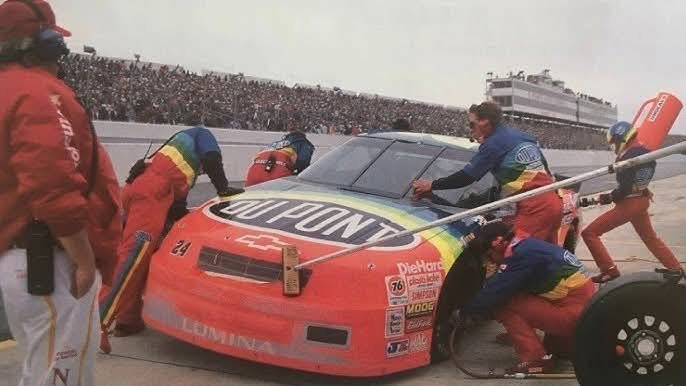
Gordon, perhaps the most well-known LASTCAR Cup Series Champion, was competing in his first full season of Cup Series competition. A standout in several racing divisions, including the NASCAR Busch Grand National Series where he finished 4th in the 1992 point standings, Gordon finished 31st in his Cup Series debut for owner Rick Hendrick at Hampton, Georgia on November 15, 1992. In 1993, Gordon and his rainbow-hued #24 DuPont Automotive Finishes Chevrolet burst onto the scene in dramatic style with a win in his Gatorade Twin 125-mile Qualifier at Daytona Beach, Florida, followed by a 5th-place finish in the Daytona 500. In the end, Gordon finished 14th in points, scoring seven Top Fives, eleven Top Tens, and his first career pole in Concord, North Carolina.
So, how did Gordon win the LASTCAR Cup Series Championship?
In the same thirty starts during the 1993 season, Gordon racked-up eleven DNFs, dragging his average finish down to 17.7. His two last-place finishes came in a season sweep of both races at North Wilkesboro, North Carolina. In the First Union 400 on April 18, Gordon started 7th, but wrecked in turn one on Lap 26, taking him out of the race. On October 3, trouble found him on the opening lap of the Tyson / Holly Farms 400. That day, outside-polesitter Ricky Rudd jumped the start and throttled back, which caused the entire outside line to accordion in a seven-car pileup. Gordon, in the 16th spot, had nowhere to go. Though he returned to the track to complete 117 laps, handling woes stopped his advance and he wound up in last place.
The rest of Gordon’s career is well-known. In a career spanning 797 starts through his retirement at the end of the 2015 season, Gordon scored four NASCAR Cup Series Championships and ninety-three wins - including the final Cup race run (for now) at North Wilkesboro on September 29, 1996 - putting him third on the all-time list behind Richard Petty and David Pearson. As of this writing, Jeff Gordon is not only the winningest LASTCAR Cup Series Champion, but the only driver to ever score both a NASCAR and LASTCAR Cup Series Championship.
Gordon finished last in just three other Cup Series races. The first of those three came on March 9, 1997 in the PRIMESTAR 500, the final race run on the old 1.522-mile configuration at Atlanta Motor Speedway in Hampton, Georgia when he lost the engine after 59 laps. The other two came at the Texas Motor Speedway in Fort Worth, Texas: the Primestar 500 on March 28, 1999 where he crashed after 68 laps, and the Samsung 500 on April 6, 2008, where damage from an earlier wreck ended his run at 124 laps. Gordon went on to win the 2009 running of the event, his first at the Texas track. He didn’t finish last again in the rest of his Hall of Fame career, which concluded with a 6th-place run at Martinsville on October 30, 2016.
OTHER LASTCAR HEADLINES
At Darlington, South Carolina on March 28, Norm Benning scored the final Cup Series last-place finish for Oldsmobile, a manufacturer which pulled out of NASCAR after campaigning cars since 1949. That day in Darlington, Benning’s #63 O’Neil Racing Oldsmobile fell out with handling problems after he completed just the opening lap. Benning would try and get his Oldsmobile into four more races in 1993 and 1994, including the inaugural Brickyard 400, but was unsuccessful. As of this writing, Benning is still seeking his first Cup Series start since that Darlington race, having attempted to qualify for the Daytona 500 as recently as 2010. On July 24, 2013, Benning stole the show in the Truck Series race at Eldora with a thrilling door-to-door battle with Clay Greenfeld in the Last Chance Qualifier.
Finishing 34th in that Darlington race was 58-year-old owner-driver James Hylton, who was making his 602nd - and, as of this writing, most recent - NASCAR Cup Series start. One month earlier on February 28, Hylton scored his ninth last-place finish in the GM Goodwrench 500 at Rockingham, North Carolina when his #48 Rumple Furniture Pontiac busted the oil pan after 24 laps.
In 2007, at age 72, Hylton acquired a Chevrolet from Richard Childress Racing and nearly raced the #58 into the Daytona 500 field before mechanical woes dropped him back in his qualifying race. On May 6, 2011, at age 76, Hylton became the oldest driver to start a NASCAR Busch Series race and NASCAR’s oldest last-place finisher when his #0 G&K Services Chevrolet broke a rear end after two laps of the Royal Purple 200 in Darlington, South Carolina. Hylton retired from the ARCA Racing Series on October 4, 2013 at the age of 78.
Though Hylton holds the record for NASCAR’s oldest last-place finisher, the record for the oldest last-place driver in the Cup Series goes to another ageless wonder - Hershel McGriff. At Sonoma, California on May 16, McGriff at age 65 years, 5 months, and 2 days became the oldest last-place finisher in Cup Series history when his #04 J.T. Carriers Chevrolet lost the engine after 27 laps of the Save Mart Supermarkets 300. It was McGriff’s fourth last-place finish. He would hold the record as the Cup Series’ oldest last-place finisher until March 2, 2014, when Morgan Shepherd finished last at Phoenix at 72 years, 4 months, and 18 days.
Bobby Labonte, who battled Jeff Gordon and Kenny Wallace for Rookie of the Year, also scored his first Cup Series last-place finish in 1993. Labonte, driving for Bill Davis Racing, Gordon’s Busch Series team in 1992, finished last in the Pepsi 400 on July 3 when his #22 Maxwell House Ford was involved in a multi-car pileup on Lap 22 along with Jimmy Spencer, Hut Stricklin, Jimmy Horton, and Kyle Petty. Labonte would make the move to Joe Gibbs Racing in 1995, the #18 Interstate Batteries team producing all twenty-one of his Cup Series wins to date, including the 2000 NASCAR Cup Series Championship.
A week after the Daytona event, Jerry O’Neil became the first Cup Series last-place finisher at the new 1.058-mile track in Loudon, New Hampshire when his #65 Aroneck Racing Chevrolet was taken out in a four-car accident after he completed nine laps of the inaugural Slick 50 300.
Two days after the Loudon race, Davey Allison died from injuries suffered in a helicopter crash at Talladega, Alabama. It was the second loss of a NASCAR star in just over three months following the death of defending NASCAR Cup Series Champion Alan Kulwicki in a plane crash outside Blountville, Tennessee on April 1.
Like Kulwicki’s team did at Bristol, Tennessee on April 4, Allison’s Robert Yates Racing teammates withdrew from the next race after the crash July 18 at Long Pond, Pennsylvania, setting up an emotional return one week later at the Talladega Superspeedway. Tabbed to drive the #28 Havoline Ford in the July 25 Die Hard 500 was Orange, California open-wheel racer Robby Gordon, who was making his first Cup Series start in more than two years. Gordon qualified 14th and was making his way through the pack when he clipped the apron entering the tri-oval, sending him spinning into the outside wall. The damage suffered in the crash left Gordon in the last spot that day. He was replaced by Lake Speed and, eventually, Ernie Irvan, who scored two late-season victories in Martinsville, Virginia and Concord, North Carolina.
The 1993 season ended on November 14 with an emotional Hooters 500 in Hampton, Georgia, the race where Allison and Kulwicki battled Bill Elliott for the season title just the year before. This time around, Dale Earnhardt edged Rusty Wallace to score his sixth NASCAR Cup Series Championship, successfully rebounding from his disastrous 1992 season.
Finishing last that day in Georgia was Neil Bonnett, driving a second Richard Childress-prepared Chevrolet. Four months earlier, the day Robby Gordon finished last at Talladega, Bonnett, a longtime friend of Earnhardt, debuted Childress’ #31 team in the DieHard 500, giving Bonnett his first Cup start since an injury at Darlington, South Carolina sidelined him in 1990. Bonnett’s race ended after 131 laps with a frightening flip into the trioval catchfence, but fortunately he was uninjured in the mishap. In the Hooters 500, Bonnett’s #31 Western Steer Chevrolet was there in case Earnhardt’s #3 didn’t start, so a driver change could be made before the green flag. Once Earnhardt’s car did start, Bonnett pulled behind the wall after three laps with engine failure as the listed cause, which helped make it harder for Earnhardt to have a bad enough finish to lose the title.
Bonnett, who had attained steady work as a commentator for CBS, TBS, and TNN from 1990 through 1993, including TNN’s popular program “Winners,” decided to make one more run at Cup Series racing in 1994. The plan was to compete in six more races that year, starting in the Daytona 500, where Bonnett debuted a #51 Country Time Lemonade Chevrolet fielded by owner James Finch’s Phoenix Racing. On February 11, 1994, Bonnett’s car spun out during a practice run and hit the Turn Four wall head-on, killing him instantly. He was 47. Unbelievably, that week saw another Cup Series driver lose his life when prospective rookie Rodney Orr’s #37 Daytona Auto Dealers Exchange / X-1R Ford crashed in practice three days later.
CHAMPIONSHIP STANDINGS
1st) Jeff Gordon [3 B5s, 6 B10s], Bob Schacht [3 B5s, 3 B10s] (2)
2nd) Loy Allen, Jr., Norm Benning, Rich Bickle, Brett Bodine, Geoffrey Bodine, Todd Bodine, Neil Bonnett, Wally Dallenbach, Jr., Robby Gordon, Bobby Hamilton, Jimmy Hensley, Jimmy Horton, James Hylton, Ernie Irvan, Bobby Labonte, Terry Labonte, Dave Marcis, Hershel McGriff, Jerry O'Neil, Phil Parsons, Ricky Rudd, Greg Sacks, Dorsey Schroeder, Graham Taylor, T.W. Taylor, Dick Trickle (1)