SEASON IN REVIEW
Denver, North Carolina driver Phil Parsons scored his first LASTCAR Cup Series Championship in 1989, scoring four last-place finishes in twenty-nine starts during a twenty-nine-race season. In doing so, Parsons became just the second LASTCAR Champion to compete in all of the season’s races.
Parsons was competing in his seventh season of Cup Series competition. With steady sponsorship backing from the Skoal Tobacco Company since his first start in the 1983 Daytona 500, Parsons showed gradual improvement which spiked in 1988. Coming of a career-high 14th in points driving for owners Leo and Richard Jackson in 1987, Parsons scored six Top Fives and fifteen Top Tens in 1988, including his first and only victory at Talladega, Alabama on May 1, 1988. With 108 laps led and a 9th-place finish in the points in 1988, hopes were high for even more in 1989.
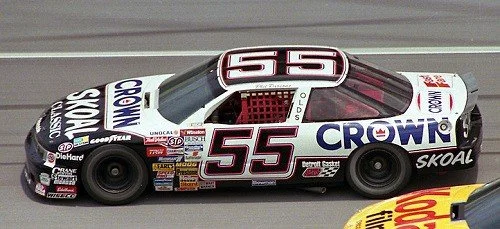
Unfortunately, 1989 was a disappointment. Parsons and his #55 Crown Petroleum / Skoal Classic Oldsmobile scored just two top Fives and three Top Tens that year, resulting in a 21st-place points finish. He missed the field for the April 16 race at North Wilkesboro, North Carolina and had to buy a ride in the #60 Combs Racing Chevrolet owned by Bob Bilby. Parsons also racked-up eight DNFs, half of them last-place finishes.
Parsons’ first last-place finish of 1989 came in the TranSouth 500 at Darlington, South Carolina. During the early stages of the April 2 race, Parsons was clawing his way up from the 21st spot when he wrecked along with Darrell Waltrip during an ill-fated pass. Parsons ended up last, having completed 83 laps. The next finish came, ironically, at Talladega, Alabama, scene of his Cup win more than a year earlier, when his engine blew after six laps of the July 30 race. Finish number three was five races after that, another crash after eight laps the cause for a 36th-place finish at Richmond, Virginia on September 10. The fourth finish came November 19 in the season finale at Hampton, Georgia, where he was again stopped after eight laps, this time due to an engine failure.
Parsons and the Jackson Brothers parted ways after the 1989 season, and Richard and Leo Jackson started their own separate race teams in 1990, both of them sponsored by Skoal products. With the exception of a 26-race 1993 season for owner Larry Hedrick, Parsons never came close to running a full Cup Series schedule again. His first ride in 1990 for Morgan-McClure Motorsports ended after just three starts, including a last-place finish in the Daytona 500. Parsons was replaced by an unheralded upstart named Ernie Irvan, who would win the Daytona 500 for McClure the very next year. Parsons’ final Cup start came at Darlington, South Carolina on March 23, 1997, when he filled in for a grieving Joe Nemechek following the death of his brother in a Truck Series race in Homestead, Florida.
That same time, Parsons turned his attention to the Busch Series, where he won two races through his final start in Sparta, Kentucky on June 16, 2001. Since then, Parsons has become a commentator for SPEED Channel and a Cup Series team owner. He currently has a one-half interest in Phil Parsons Racing, which fields a #98 Ford co-owned by record executive Mike Curb. Parsons’ cars would go on to claim four LASTCAR Cup Series Championships in 2009, 2011, 2012, and 2013.
OTHER LASTCAR HEADLINES
Rick Mast, who turned heads with a surprising 6th-place finish in just his third career start, the season-opening Daytona 500 on February 19, scored his first last-place finish seven races later in Martinsville, Virginia. Mast’s #66 Raven Boats Chevrolet lost the engine after 251 laps, leaving him 32nd in the running order. Mast would win 1990's LASTCAR Cup Series Championship in a bottom-ten tiebreaker over the Leo Jackson-owned #33 of Harry Gant.
The year 1989 saw Dale Earnhardt finish last for just the second time in his career, playing a significant role in the NASCAR Cup Series Championship battle. The finish came in the October 8 running of the All Pro Auto Parts 500 in Concord, North Carolina when his familiar #3 GM Goodwrench Chevrolet broke the camshaft after just 13 laps. This allowed 8th-place finisher Rusty Wallace to close within 35 points of Earnhardt for the season title with just four races to go. The next week in North Wilkesboro, North Carolina, Earnhardt dominated the October 15 Holly Farms 400 only to be spun by Ricky Rudd while battling for the lead on the last lap, giving Wallace a point lead he would not relinquish for the rest of the year. That North Wilkesboro race also marked the fifteenth and final last-place finish for Richard Petty, whose #43 STP Pontiac fell out with crash damage after 124 laps.
It was a frustrating loss for Earnhardt, who had to go to dramatic lengths to keep his title chances going. At Martinsville, Virginia on September 24, Jimmy Hensley was credited as the only NASCAR last-place finisher who didn’t have a car. Hensley was called to qualify Earnhardt’s #3 for the race since Hurricane Hugo prevented Earnhardt from flying to the track for qualifying. Hensley put the car on the pole, then stepped out of it on Sunday so Earnhardt could drive and get his driver’s points. Earnhardt finished 9th in the race.
In the inaugural Banquet Frozen Foods 300 at the Sears Point Raceway in Sonoma, California on June 11, Dale Jarrett became the first NASCAR Cup driver to finish last on the 2.52-mile road course. Jarrett’s #29 Hardee’s Pontiac blew the transmission after eight laps.
CHAMPIONSHIP STANDINGS
1st) Phil Parsons (4)
2nd) Butch Miller (3)
3rd) Jimmy Means, Larry Pearson (2)
4th) Charlie Baker, Neil Bonnett, Rodney Combs, Derrike Cope, Tommie Crozier, Dale Earnhardt, Bill Flowers, Jimmy Hensley, James Hylton, Dale Jarrett, Terry Labonte, Dave Marcis, Rick Mast, John McFadden, Richard Petty, Jim Sauter, Ken Schrader, Michael Waltrip (1)