SEASON IN REVIEW
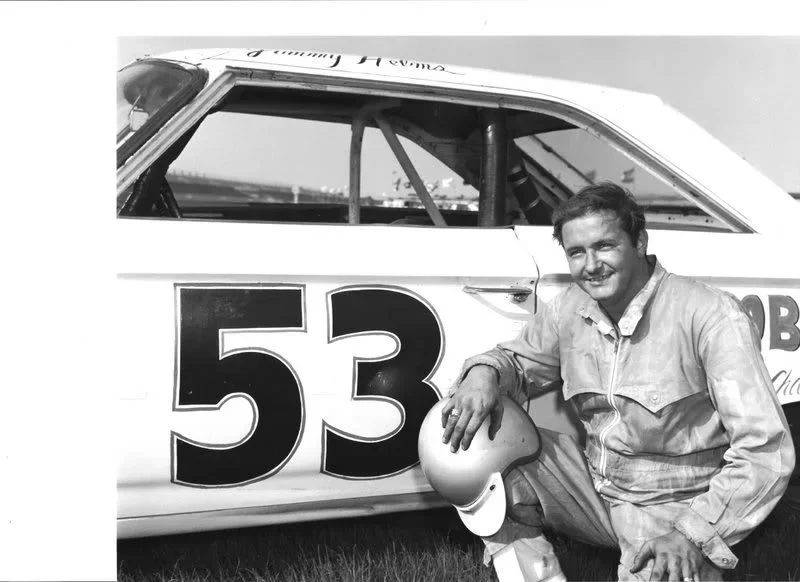
Charlotte, North Carolina driver Jimmy Helms picked up his first LASTCAR Cup Series Championship in 1965. In doing so, Helms tied Jimmy Pardue’s 1961 single-season record of five last-place finishes in a single season, this time scoring them in thirty-nine starts during a fifty-five-race season.
Helms was competing in his second season on the Cup Series tour, having earned his first two top-ten finishes in 1964. According to Helms’ interview with Perry Allen Wood, that year, he drove one of two Chryslers owned by Buck Baker, and he and teammate Neil Castles were instructed to park these cars to fund Baker’s effort – one of the first recorded examples of a “start-and-park” effort. 1965 would see Helms make the move to David Warren’s team, and he would campaign Warren’s #53 1963 Fords in all but four starts that year.
Following a pair of DNFs in Daytona and Atlanta, Helms made his first start for Warren at Bristol on May 2, earning a 12th-place finish in the 33-car field. However, just three days after scoring his second top-ten finish for Warren with a 9th-place run in Myrtle Beach, South Carolina on June 24, Helms picked up his first last-place run of the season in Valdosta, Georgia on June 27 when he lost the engine in practice and was unable to start the race. The finish was still listed as “engine failure” with one lap complete, edging Elmer Gilliam for the spot.
Helms’ next two finishes occurred in August. The first came in August, Georgia on August 15, another exit after the opening lap that was this time due to a driveshaft failure. Thirteen days later on August 28, Helms lost the brakes on his Ford just two laps into the Myers Brothers Memorial at Winston-Salem, North Carolina’s Bowman Gray Stadium.
The final two last-place runs came in consecutive races in October. During the National 400 at the Charlotte Motor Speedway on October 17, Helms finished 44th, his car gobbled-up in a tragic accident on the second lap of the race. The accident began when Rock Harn, Sonny Hutchins, and Frank Warren collided in turn three. Harold Kite, the 1950 winner at the Daytona Beach-Road Course, was making his first start in more than nine years that day and found himself directly behind the accident. Kite’s #01 1965 Plymouth spun to avoid contact as Helms moved to the apron and the two collided. Kite died soon after the accident, having suffered extreme internal injuries.
Helms, treated and released for cuts and bruises in the Charlotte wreck, was released by Warren’s team and made two more starts for owner Gene Cline. In his debut for Cline a week later in Hillsborough, North Carolina, Helms finished last for the fifth time when brake failure felled his #97 1964 Ford after just one lap.
Helms competed in just 31 more races over the next two seasons, scoring the last of his seven top-ten finishes in his final career start at Greenville, South Carolina on June 24, 1967, a 9th-place finish. His best career finish remained his 6th-place run at the Langley Speedway in Hampton, Virginia on May 14, 1965, his third start for the Warren team.
OTHER LASTCAR HEADLINES
Footage of the start of the Daytona 500 run on February 14 was used in the opening of the 1967 film “Speed Lovers,” which included some of the earliest footage of a last-place battle in a NASCAR race. Thirty seconds into the film, which starred race winner Fred Lorenzen, you can see smoke billowing from the back of 7th-place starter Larry Frank in his #76 1964 Ford as he enters turn one. Frank exited the race after the opening lap due to a loss of oil pressure. He finished 41st in a field of 43, however, as he was edged by Joe Penland and last-place finisher Robert Vaughn, who also completed just the first lap, but started behind Frank when their mechanical woes occurred. Vaughn’s #39 1963 Pontiac also lost oil pressure, while Penland’s #79 1963 Chevrolet burnt a piston. Pete Stewart’s accident on Lap 3 is also shown after the credits, though with fourteen cars falling out in the first six laps, his #53 1963 Ford finished 37th.
David Pearson, well on his way to becoming “The Silver Fox” in 1965, scored his first last-place finish that season at Bristol, Tennessee on July 25. Pearson’s #6 Cotton Owens-prepared 1965 Dodge was involved in a two-car crash with the Wood Brothers machine of Marvin Panch as the two raced for 5th on Lap 9. Pearson and Panch’s team owner Glen Wood nearly came to blows on pit road before the two were broken up. Pearson won two races in 1965, the twelfth and thirteenth victories in what would become a 105-win career.
Jack Ingram, who would go on to win 31 Busch Grand National Series races from 1982 through 1987, scored the only last-place finish of his NASCAR Cup Series career in 1965 when he drover for Elmo Langley at Hickory, North Carolina on September 10, only to have his #64 1964 Ford fall out with handling woes after four laps.
Four days before Ingram’s finish, 1960 LASTCAR Cup Series Champion Junior Johnson won the pole for the Southern 500 at the Darlington Raceway on September 6, only to lose the ignition and finish last for the 16th time in his career. Johnson completed just the opening lap, having fallen out just seconds before the Lap 3 multi-car wreck that took the life of rookie driver Buren Skeen. The race went on to see Ned Jarrett win the race by 14 laps and one car length over Buck Baker, who was relieved by his son Buddy in the closing stages. It was Jarrett’s first and only victory at the track that was the scene of his first last-place finish in 1953.
CHAMPIONSHIP STANDINGS
1st) Jimmy Helms (5)
2nd) Buddy Arrington (4)
3rd) Buddy Baker, Raymond Carter, Wayne Smith, Cale Yarborough (3)
4th) Neil Castles, Darel Dieringer, Bert Robbins, G.C. Spencer, E.J. Trivette (2)
5th) Barry Brooks, Jim Conway, Danny Byrd, Bob Derrington, Stick Elliott, Jack Goodwin, Gene Hobby, Jack Ingram, Junior Johnson, Roy Mayne, Bud Moore, Terry Murchison, G.T. Nolan, David Pearson, Joe Penland, Bob Perry, Richard Petty, Tom Pistone, J.T. Putney, Wendell Scott, Junior Spencer, Jabe Thomas, Robert Vaughn, Ken White (1)